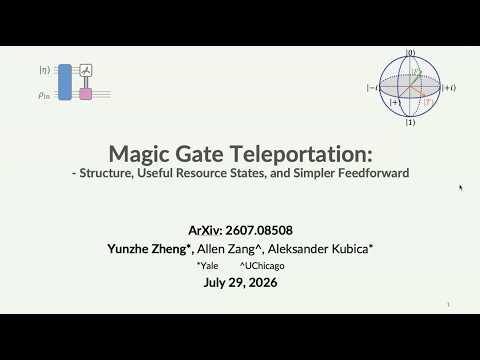
81 | Magic Gate Teleportation: Structure, Useful Resource States, and Simpler Feedforward
This talk develops a theory of magic gate teleportation, revealing structural properties that identify useful resource states for non-Clifford gates and simplify the feedforward operations required for fault-tolerant computation.
78 | Quantum Arithmetic: From Fundamental Building Blocks to Practical Quantum Algorithms
Arithmetic circuits are among the most fundamental building blocks of quantum computing. This talk introduces the principles behind quantum arithmetic circuit design and the key challenges in optimizing quantum addition, subtraction, multiplication, and division circuits for practical quantum algorithms.
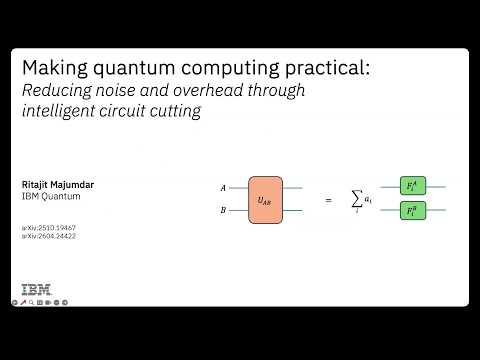
77 | Making quantum computing practical: reducing noise and overhead through intelligent circuit cutting
Noise in current quantum devices poses a major obstacle to running large and meaningful quantum algorithms. One promising approach to overcome hardware limitations is circuit cutting, where large quantum circuits are decomposed into smaller pieces that can be executed more reliably. However, this comes at a cost: the number of required circuit executions can grow exponentially with the number of cuts, making naïve approaches impractical. In this talk, we explore two complementary directions that make circuit cutting significantly more efficient and practical on today’s quantum hardware. First, we show how combining circuit cutting with operator backpropagation (OBP) can strategically reduce circuit depth, thus controlling the growth in execution overhead. Our approach formulates this as an optimization problem, enabling substantial reductions in resource requirements for common quantum workloads without sacrificing accuracy. Building on this, we examine a key real-world insight: noise in quantum hardware is not uniform. We present a noise-aware framework that uses this structure to guide circuit cutting strategies. By aligning subcircuits with low-noise regions and carefully relaxing device constraints, we show that it is possible to achieve dramatic reductions in execution cost while preserving fidelity, even for larger systems where standard methods break down. Together, these works highlight a broader message: making quantum computing practical is not only about better hardware alone, but also about smarter ways of adapting algorithms to real devices. The talk will introduce the key ideas intuitively, discuss the main techniques, and provide insights into how theory and systems considerations come together in modern quantum computing research.
73 | Quantum Computing with Oscillators and Qubits
Hardware platforms based on native continuous-variable (CV, oscillator) systems have attracted growing attention as an alternative to discrete-variable (DV, qubit) quantum systems. In this talk, I will highlight how hybrid CV-DV hardware offers a powerful computational paradigm by combining the complementary strengths of both CV and DV processors. I will present novel quantum control techniques and algorithms for CV-DV systems that enable new opportunities and applications in quantum error correction, quantum simulation, and quantum sensing. I will also highlight software tools for benchmarking and compiling these novel processors.
71 | Using Quantum Probability to Understand Contextual Reasoning
What kind of logic do people use to reason about natural events? What kind of probability theory best describes how people make inferences and decisions under uncertainty?
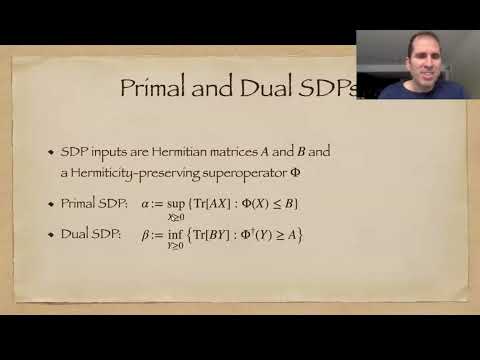
58 | Variational Quantum Semi-definite Programming
Solving optimization problems is a key task for which quantum computers could possibly provide a speedup over the best known classical algorithms.
42 | Align or Not Align? Design Quantum Approximate Operator Ansatz (QAOA) with Applications in Constrained Optimization
Combinatorial optimization has been one of most promising use cases of the near-term quantum computers.
41 | The Nonequilibrium Cost of Accuracy
Accurate information processing is crucial both in technology and in nature.
40 | Parameter Setting in Quantum Approximate Optimization of Weighted Problems
Quantum Approximate Optimization Algorithm (QAOA) is a leading candidate algorithm for solving combinatorial optimization problems on quantum computers.
33 | Quantum Graphical Calculi: Tutorial and Applications
Quantum computing and quantum communication provide potential speed-up and enhanced security compared with their classical counterparts.
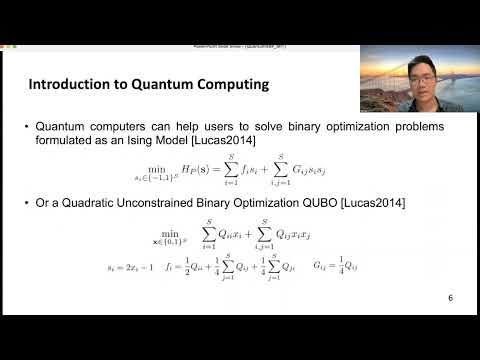
30 | Efficient Hamiltonian Reduction for Scalable Quantum Computing on Clique Cover/Graph Coloring Problems in SatCom
Clique cover and graph coloring are complementary problems which have many applications in wireless communications, especially in satellite communications (SatCom).
29 | Rethinking Most-significant Digit-first Arithmetic for Quantum Computing in NISQ Era
In recent years, quantum computers have attracted extensive research interest due to their potential capability of solving problems which are not easily solvable using classical computers.
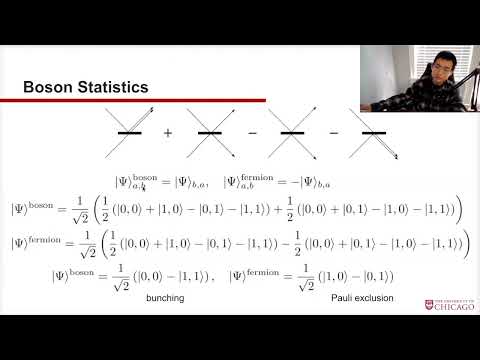
27 | Understanding Quantum Supremacy Conditions for Gaussian Boson Sampling with High Performance Computing
Recent quantum supremacy experiments demonstrated with boson sampling garnered significant attention, while efforts to perfect approximate classical simulation techniques challenge supremacy claims on different fronts.
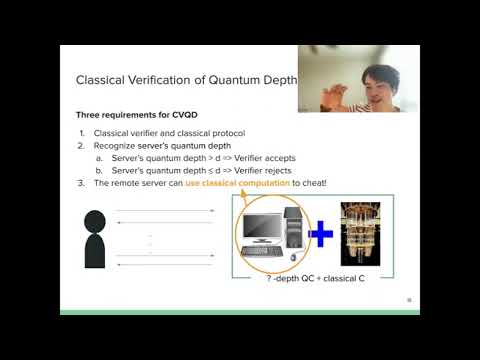
19 | Classical Verification of Quantum Depth
Verifying if a remote server has sufficient quantum resources to demonstrate quantum advantage is a fascinating question in complexity theory as well as a practical challenge.
10 | Solving Nonlinear Partial Differential Equations using Variational Quantum Algorithms on Noisy Quantum Computers
Partial differential equations (PDEs) have long been the center of interest to system modeling in many disciplines of science and engineering, such as computational physics, fluid mechanics, and quantitative finance.
4 | Enabling Parallel Circuit Execution on NISQ Hardware
Today’s quantum computers are in the Noisy Intermediate-Scale Quantum era and prone to errors.
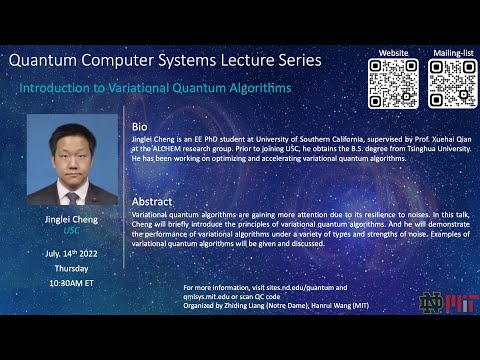
3 | Introduction to Variational Quantum Algorithms
A lecture by Jinglei Cheng on quantum computing.