Lectures
Explore our collection of quantum computing lectures, ranging from introductory topics to advanced research. Learn from experts across academia and industry.
Explore our collection of quantum computing lectures, ranging from introductory topics to advanced research. Learn from experts across academia and industry.
This talk presents a noise-aware framework for allocating quantum circuit shots, reducing the execution cost, energy consumption, and estimation error of near-term quantum workloads.
This talk presents systems-level architectural principles and compiler techniques for improving cycle time, reducing cycles per gate, and lowering gate count in scalable fault-tolerant quantum computing.
This talk presents experiments that probe the overlap between quantum physics and general relativity, and discusses the prospect of definitive tests of the quantum nature of the gravitational field.
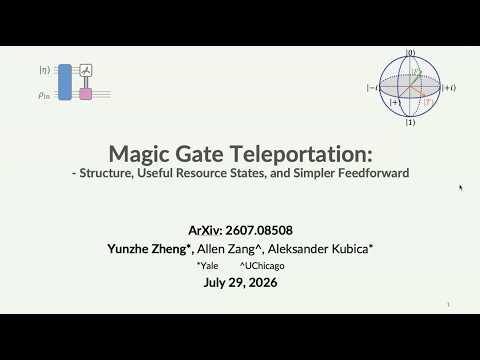
This talk develops a theory of magic gate teleportation, revealing structural properties that identify useful resource states for non-Clifford gates and simplify the feedforward operations required for fault-tolerant computation.
This talk presents techniques for reducing T-gate counts, Clifford gate counts, and compilation costs, together with a scalable framework for efficiently compiling large fault-tolerant quantum circuits.
This talk presents a co-designed family of ultra-high-rate quantum error correction codes for reconfigurable neutral atom arrays, with efficient syndrome extraction, atom rearrangement, and promising practical logical error rates.
Arithmetic circuits are among the most fundamental building blocks of quantum computing. This talk introduces the principles behind quantum arithmetic circuit design and the key challenges in optimizing quantum addition, subtraction, multiplication, and division circuits for practical quantum algorithms.
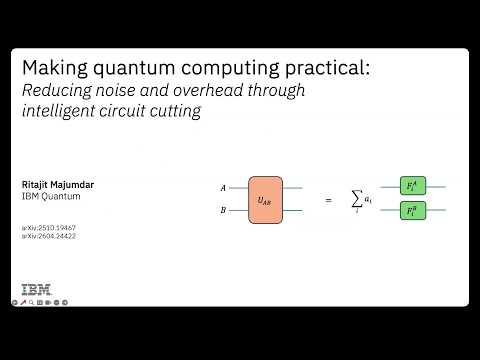
Noise in current quantum devices poses a major obstacle to running large and meaningful quantum algorithms. One promising approach to overcome hardware limitations is circuit cutting, where large quantum circuits are decomposed into smaller pieces that can be executed more reliably. However, this comes at a cost: the number of required circuit executions can grow exponentially with the number of cuts, making naïve approaches impractical. In this talk, we explore two complementary directions that make circuit cutting significantly more efficient and practical on today’s quantum hardware. First, we show how combining circuit cutting with operator backpropagation (OBP) can strategically reduce circuit depth, thus controlling the growth in execution overhead. Our approach formulates this as an optimization problem, enabling substantial reductions in resource requirements for common quantum workloads without sacrificing accuracy. Building on this, we examine a key real-world insight: noise in quantum hardware is not uniform. We present a noise-aware framework that uses this structure to guide circuit cutting strategies. By aligning subcircuits with low-noise regions and carefully relaxing device constraints, we show that it is possible to achieve dramatic reductions in execution cost while preserving fidelity, even for larger systems where standard methods break down. Together, these works highlight a broader message: making quantum computing practical is not only about better hardware alone, but also about smarter ways of adapting algorithms to real devices. The talk will introduce the key ideas intuitively, discuss the main techniques, and provide insights into how theory and systems considerations come together in modern quantum computing research.
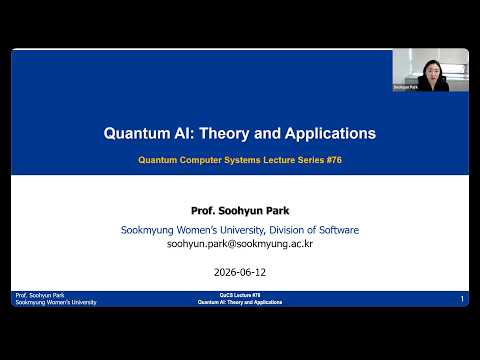
This course covers various Quantum AI technologies based on Parameterized Quantum Circuits (PQC), one of the quantum technologies that has recently attracted significant attention. To facilitate a clear understanding of PQC-based quantum AI, the course first introduces quantum neural network architectures by integrating fundamental concepts of classical artificial neural networks with quantum computing theory. Building upon this foundation, the course then explores advanced Quantum AI models, including Quantum Reinforcement Learning (QRL), Quantum Federated Learning (QFL), and Quantum Convolutional Neural Networks (QCNNs). Finally, through representative research cases in which Quantum AI algorithms are applied across diverse domains, the course examines the advantages of Quantum AI technologies and their potential for future research directions.
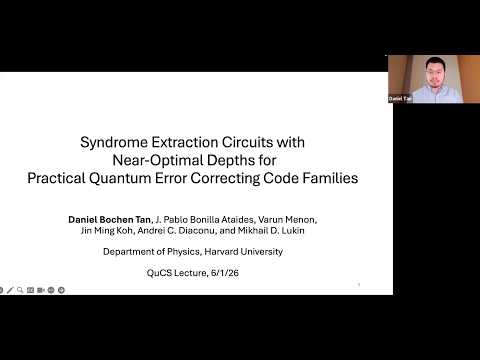
Fault-tolerant quantum computing relies on low-depth and high-fidelity syndrome extraction for quantum error correcting codes. We propose a scheduling strategy for syndrome extraction circuits for the broad class of quasi-abelian lifted-product codes, encompassing both hypergraph product and bicycle codes. Our approach constructs syndrome extraction circuits with CNOT depths no more than one layer above the fundamental lower bound, frequently achieving optimal depth. A pipelined variant further reduces the average depth per round, and the strategy generalizes naturally to higher-dimensional product codes. This scheduling framework enables computational speedups for quantum computing architectures built on these codes, all while preserving high-fidelity error correction.
Recent advances in quantum algorithms and hardware have enabled the exploration of quantum techniques for industrially relevant challenges in optimization, simulation and machine learning. This talk will highlight IBM’s latest advancements in quantum hardware and present early experimental results from applications across multiple industry domains. Attendees will gain insight into the motivations driving adoption, the classes of problems quantum computing can tackle and the opportunities it offers for shaping the future of industrial innovation.
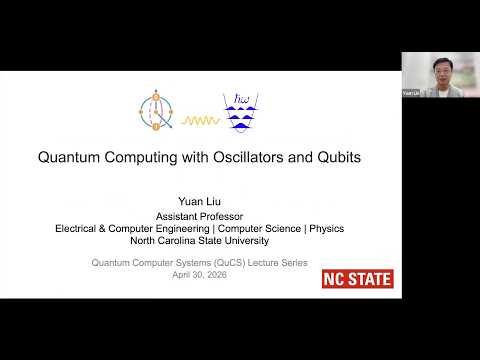
Hardware platforms based on native continuous-variable (CV, oscillator) systems have attracted growing attention as an alternative to discrete-variable (DV, qubit) quantum systems. In this talk, I will highlight how hybrid CV-DV hardware offers a powerful computational paradigm by combining the complementary strengths of both CV and DV processors. I will present novel quantum control techniques and algorithms for CV-DV systems that enable new opportunities and applications in quantum error correction, quantum simulation, and quantum sensing. I will also highlight software tools for benchmarking and compiling these novel processors.
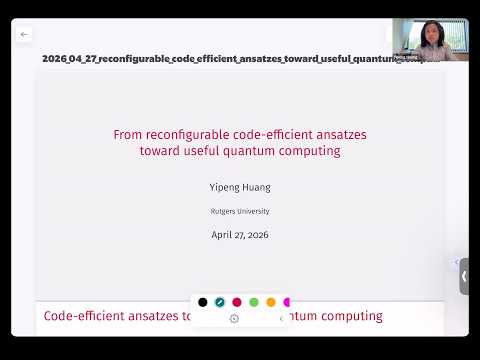
The full impact of quantum computing (QC) will depend on quantum error-correcting codes (QECCs). This talk explores whether useful QC might be ushered in without waiting for the arbitrarily low logical error rates enabled by integrating millions of physical qubits. Instead, a universal set of quantum operations might be enabled by cleverly switching among a wide family of QECCs, some codes that provide precise rotations, while others provide parallel operations. Based on this idea, I present recent work on scheduling hardware operations for such a scheme and discuss how it may affect QC applications in Hamiltonian simulation. The exploration sheds light on the question: How far away is useful QC?
What kind of logic do people use to reason about natural events? What kind of probability theory best describes how people make inferences and decisions under uncertainty?
Major advances across all the design stack of Quantum computing – algorithm, software, and hardware – has brought us to a realm where, it is impossible to ignore the effect of Quantum computing in the world around us.
Compiling a quantum algorithm to run on a quantum computer consisting of a 2D array of qubits with only nearest neighbor interactions is a complex problem.
This lecture discusses how integrated hardware–software co-design can address key challenges in scalable quantum computing.
Quantum recursive programming has recently been introduced for describing sophisticated and complicated quantum algorithms in a compact and elegant way.
Quantum computing lecture from the QuCS series.
Quantum computing lecture from the QuCS series.
Quantum error correction has become a crucial and popular topic, especially given its essential role in ensuring the scalability and reliability of quantum computers.
Quantum computing lecture from the QuCS series.
Quantum computing lecture from the QuCS series.
Quantum computing lecture from the QuCS series.
Quantum computing lecture from the QuCS series.
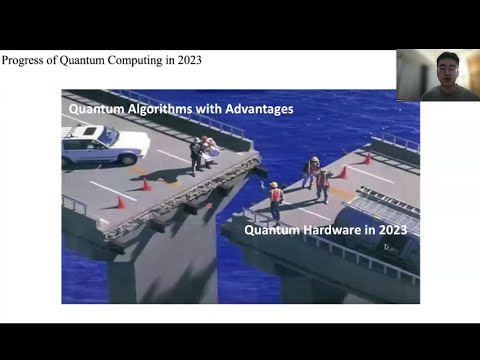
Quantum computing has made significant progress in recent years.
Over the past decade, quantum computing has experienced remarkable growth and development, opening up new possibilities for simulating molecular properties.
The second quantum revolution, the transition from quantum theory to quantum engineering, is leading us toward practical quantum computing.
The full promise of quantum computation will only be realized if quantum devices scale.
We introduce ODEgen, a new method for evaluating analytic gradients of quantum pulse programs and contrast it with the stochastic parameter-shift rule.
The goal of numerical quantum control is to automate the gate design process, with the promise of rapid and flexible gate design for arbitrary systems.
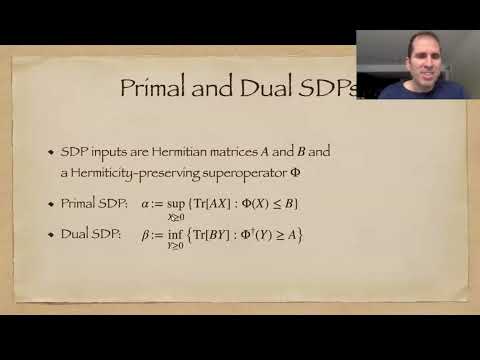
Solving optimization problems is a key task for which quantum computers could possibly provide a speedup over the best known classical algorithms.
Quantum dynamics in real-world scenarios seldom stand alone; they occur under the continuous influence of surrounding environments.
This talk will provide the full picture of design automation for quantum computing - from designing quantum algorithms and quantum circuits to quantum computing using physical quantum hardware.
High-fidelity entanglement is a prerequisite for almost any quantum information processing task.
Quantum computing lecture from the QuCS series.
Quantum computing lecture from the QuCS series.
Quantum computing lecture from the QuCS series.
Combinatorial optimization has been one of most promising use cases of the near-term quantum computers.
Zheng (Eddy) Zhang is an Associate Professor at Rutgers University.
Quantum computing lecture from the QuCS series.
At the heart of the next-level quantum technology like quantum computing lies the problem of actively controlling the dynamics of a quantum system.
Several prominent quantum computing algorithms—including Grover’s search algorithm and Shor’s algorithm for finding the prime factorization of an integer—employ subcircuits termed ‘oracles’ that embed a specific instance of a mathematical function into a corresponding bijective function that is then realized as a quantum circuit representation.
Accurate information processing is crucial both in technology and in nature.
The field of quantum computing has rapidly developed around a cloud model, in which users receive a remote handle to a quantum system, compile (transpile) quantum programs (circuits) for the target system, and then remotely invoke an execution on the system from which they then fetch the results of.
Quantum Approximate Optimization Algorithm (QAOA) is a leading candidate algorithm for solving combinatorial optimization problems on quantum computers.
State-of-the-art noisy digital quantum computers can only execute short-depth quantum circuits.
Quantum compiler plays a critical role in practical quantum compilation, particularly in the Noise-Intermediate-Scale-Quantum (NISQ) era.
The development of machine learning (ML) and quantum computing (QC) hardware has generated a lot of interest in creating quantum machine learning (QML) applications.
Benefited from the technology development of controlling quantum particles and constructing quantum hardware, quantum computation has attracted more and more attention in recent years.
In recent years, there has been a significant breakthrough in the development of superconducting quantum computers, with IBM’s 433-qubit quantum computer being a prime example of the progress made in addressing scalability issues.
Quantum computing and quantum communication provide potential speed-up and enhanced security compared with their classical counterparts.
Quantum computing and quantum communication provide potential speed-up and enhanced security compared with their classical counterparts.
Finance has been identified as the first industry sector to benefit from quantum computing, due to its abundance of use cases with exponential complexity and the fact that, in finance, time is of the essence, which makes the case for solutions to be computed with high accuracy in real time.
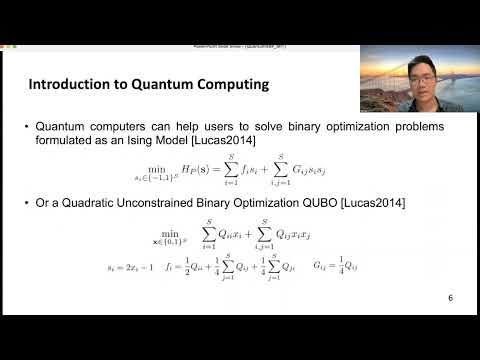
Clique cover and graph coloring are complementary problems which have many applications in wireless communications, especially in satellite communications (SatCom).
In recent years, quantum computers have attracted extensive research interest due to their potential capability of solving problems which are not easily solvable using classical computers.
In superconducting quantum computer, quantum gates are compiled down to a sequence of microwave pulses.
In this talk, I present abstractions that help classical developers reason about the quantum world, with the goal of designing expressive and sound tools for quantum programming.
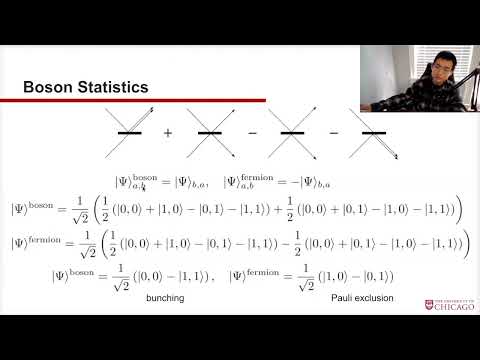
Recent quantum supremacy experiments demonstrated with boson sampling garnered significant attention, while efforts to perfect approximate classical simulation techniques challenge supremacy claims on different fronts.
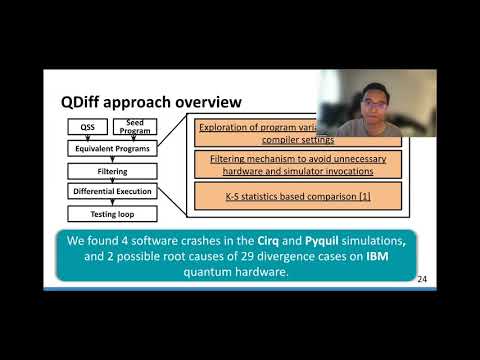
Several quantum software stacks (QSS) have been developed in response to rapid hardware advances in quantum computing.
Quantum compilers are essential in the quantum software stack but are error-prone.
Recent experimental results suggest that continuous-time analog quantum simulation would be advantageous over gate-based digital quantum simulation in the Noisy Intermediate-Size Quantum (NISQ) machine era.
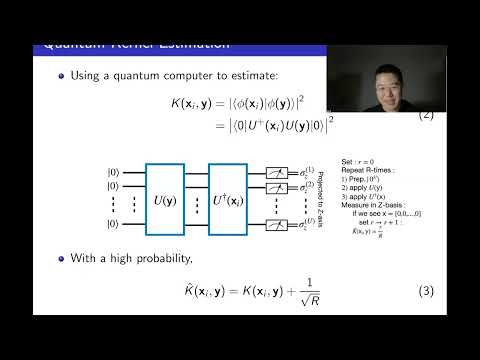
Quantum machine learning (QML) is a trailblazing research subject that integrates quantum computing and machine learning.
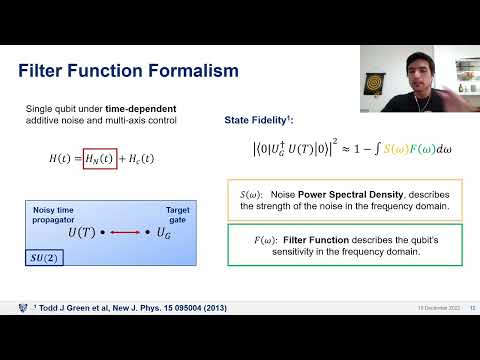
The influence of noise in quantum dynamics is one of the main factors preventing Noisy Intermediate-Scale Quantum (NISQ) devices from performing useful quantum computations.
Quantum computing presents fascinating new opportunities for various applications, including machine learning, simulation, and optimization.
A quantum compiler is one essential and critical component in a quantum computing system to deploy and optimize the quantum programs onto the underlying physical quantum hardware platforms.
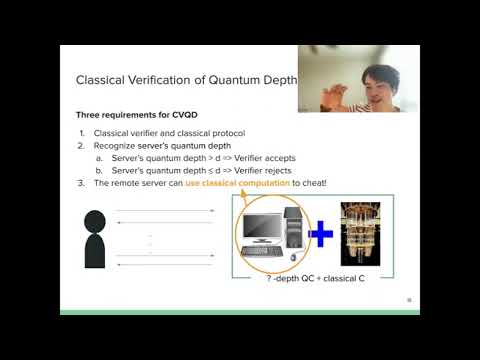
Verifying if a remote server has sufficient quantum resources to demonstrate quantum advantage is a fascinating question in complexity theory as well as a practical challenge.
The field of quantum computing has observed extraordinary advances in the last decade, including the design and engineering of quantum computers with more than a hundred qubits.
Quantum processing units (QPUs) have to satisfy highly demanding quantity and quality requirements on their qubits to produce accurate results for problems at useful scales.
The prevalence of quantum crosstalk in current quantum devices poses challenges to achieving high-fidelity quantum logic operations and reliable quantum processing.
The most challenging stage in compilation for near-term quantum computing is qubit mapping, also called layout synthesis, where qubits in quantum programs are mapped to physical qubits.
The growth of the need for quantum computers in many domains such as machine learning, numerical scientific simulation, and finance has urged quantum computers to produce more stable and less error-prone results.
Quantum information technologies are expected to enable transformative technologies with wide-ranging global impact.
As Quantum Computer device research continues to advance rapidly, there are also advances at the other levels of the computer system stack that involve these devices.
Partial differential equations (PDEs) have long been the center of interest to system modeling in many disciplines of science and engineering, such as computational physics, fluid mechanics, and quantitative finance.
Quantum entanglement enables important computing applications such as quantum key distribution.
We propose the Quantum Data Center (QDC), an architecture combining Quantum Random Access Memory (QRAM) and quantum networks.
Shadow tomography is a fundamental problem in quantum computing, whose goal is to efficiently learn an unknown d-dimensional quantum state using projective measurements.
Today’s quantum computers are in the Noisy Intermediate-Scale Quantum era and prone to errors.
Quantum computing is becoming a reality, but automated methods and software tools for this technology are just beginning.
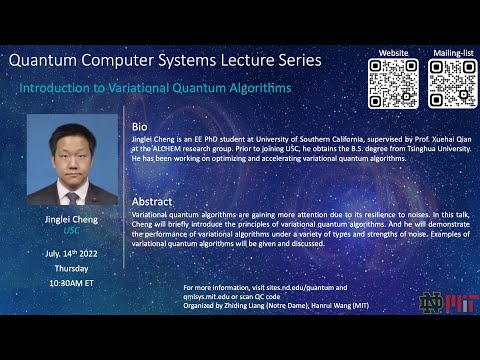
A lecture by Jinglei Cheng on quantum computing.
A lecture by Zhixin Song on quantum computing.
I will talk about recent developments in noise mitigation techniques for quantum computers. In the Noisy Intermediate-Scale Quantum (NISQ) era, qubits have short lifetimes and quantum gates are prone to errors. This talk will provide an overview of software and algorithmic approaches to mitigate quantum noise.