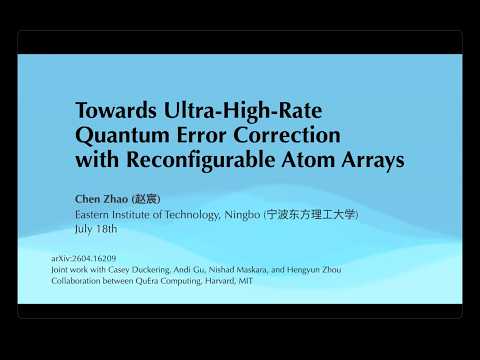
79 | Towards Ultra-High-Rate Quantum Error Correction with Reconfigurable Atom Arrays
This talk presents a co-designed family of ultra-high-rate quantum error correction codes for reconfigurable neutral atom arrays, with efficient syndrome extraction, atom rearrangement, and promising practical logical error rates.
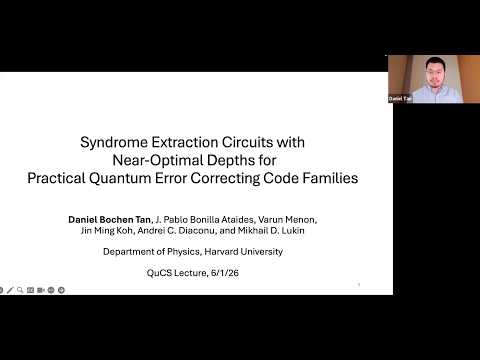
75 | Syndrome Extraction Circuits with Near-Optimal Depths for Practical Quantum Error Correcting Code Families
Fault-tolerant quantum computing relies on low-depth and high-fidelity syndrome extraction for quantum error correcting codes. We propose a scheduling strategy for syndrome extraction circuits for the broad class of quasi-abelian lifted-product codes, encompassing both hypergraph product and bicycle codes. Our approach constructs syndrome extraction circuits with CNOT depths no more than one layer above the fundamental lower bound, frequently achieving optimal depth. A pipelined variant further reduces the average depth per round, and the strategy generalizes naturally to higher-dimensional product codes. This scheduling framework enables computational speedups for quantum computing architectures built on these codes, all while preserving high-fidelity error correction.
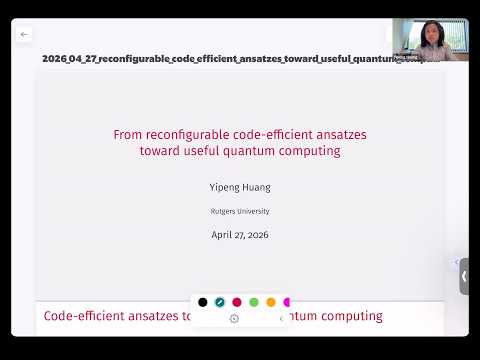
72 | From reconfigurable code-efficient ansatzes toward useful quantum computing
The full impact of quantum computing (QC) will depend on quantum error-correcting codes (QECCs). This talk explores whether useful QC might be ushered in without waiting for the arbitrarily low logical error rates enabled by integrating millions of physical qubits. Instead, a universal set of quantum operations might be enabled by cleverly switching among a wide family of QECCs, some codes that provide precise rotations, while others provide parallel operations. Based on this idea, I present recent work on scheduling hardware operations for such a scheme and discuss how it may affect QC applications in Hamiltonian simulation. The exploration sheds light on the question: How far away is useful QC?
69 | TQEC Tool Overview
Compiling a quantum algorithm to run on a quantum computer consisting of a 2D array of qubits with only nearest neighbor interactions is a complex problem.
64 | Decoder for quantum error correction codes: from the perspective of classical error correction codes
Quantum error correction has become a crucial and popular topic, especially given its essential role in ensuring the scalability and reliability of quantum computers.
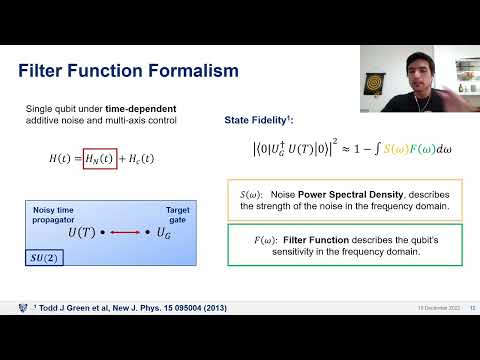
22 | Noise Modeling of the IBM Quantum Experience
The influence of noise in quantum dynamics is one of the main factors preventing Noisy Intermediate-Scale Quantum (NISQ) devices from performing useful quantum computations.
13 | Enabling robust quantum computer system by understanding errors from NISQ machines
The growth of the need for quantum computers in many domains such as machine learning, numerical scientific simulation, and finance has urged quantum computers to produce more stable and less error-prone results.
8 | Classical Support and Error Mitigation for Variational Quantum Algorithms
In this seminar Dr.
1 | Software and Algorithmic Approaches to Quantum Noise Mitigation: An Overview
I will talk about recent developments in noise mitigation techniques for quantum computers. In the Noisy Intermediate-Scale Quantum (NISQ) era, qubits have short lifetimes and quantum gates are prone to errors. This talk will provide an overview of software and algorithmic approaches to mitigate quantum noise.